
Table of Contents
- How to Host Large Group Dinners Without the Panic
- Your Large Group Dinner Planning Checklist
- Group Dinner Invitation Wording That Gets Real RSVPs
- Easy Meals for Large Groups That Scale Cleanly
- Seating and Service Styles for a Crowded House
- Your Large Group Dinner Timeline, Start to Finish
- Dietary Needs, Allergies, and Sharing the Work
- When to Move the Party to a Venue Instead
- Frequently Asked Questions
Last Updated: October 7, 2026
How to Host Large Group Dinners Without the Panic
Learning how to host large group dinners comes down to one shift: stop treating it like a dinner party for twenty and start treating it like a small operation with a plan.
The panic usually shows up in the last hour: twenty people due, the kitchen in chaos. That’s not a personality flaw, it’s a planning gap.
A large group dinner is any sit-down meal where the guest count outgrows your normal cooking and seating routine, usually eight people or more.
The host’s job is not to cook everything. It’s to control the guest count, the space, and the timeline. Everything else can be shared or simplified.
Your Large Group Dinner Planning Checklist
A large group dinner planning checklist works best in order: guest count sets the room, the room sets the menu, and the menu sets the timeline.
Lock the Guest Count First
Guest count drives everything else, so nail it down before you plan a single dish. Send invitations with a hard RSVP date 10 to 14 days out, then build in a buffer of two to three extra seats, someone always brings a plus-one or forgets to reply.
- Set a firm RSVP deadline
- Add a buffer of 2-3 seats
- Confirm the final number 3 days out
Match the Room to the Group
Different home layouts handle a crowd differently:
| Home Layout | Best Seating Approach | Comfortable Max |
|---|---|---|
| Small dining room | Push tables against walls, use benches | 8-10 |
| Open-concept kitchen | One long table, kitchen island as buffet | 12-16 |
| Living room with no table | Rent folding tables, seat in a U-shape | 14-18 |
| Backyard or patio | Long rented tables, family-style service | 20+ |
The rule of thumb: give each guest about 24 inches of table width (Round Or Rectangle: Which Dining Room Table Shape Is Right For You?). Below that, elbows collide and plates crowd.
Group Dinner Invitation Wording That Gets Real RSVPs
Group dinner invitation wording should tell guests exactly what to expect, so they reply without a follow-up text. Vague invites get vague answers. Clear invites get firm yeses and nos.
A good invitation answers five questions:
- What is it? (casual dinner, holiday meal, birthday)
- When and where?
- What should I bring, if anything?
Here’s a template you can copy:
Hi everyone! We’re hosting a big group dinner on Saturday, November 14 at 6 PM at our place. It’s a casual, family-style meal, so come comfortable. Please bring one side dish or dessert if you can. RSVP by November 7 so we can plan the food. Text me your answer. Can’t wait to see you all.
No one has to guess, and you get real numbers to plan around.
Easy Meals for Large Groups That Scale Cleanly
Easy meals for large groups share three traits: they hold well, they scale in one pot or pan, and they don’t need last-minute fussing. Avoid dishes plated to order and go for food that sits happily on a buffet line.
- Braised meats: pulled pork, beef chili, chicken tinga
- Big-batch starches: rice pilaf, roasted potatoes, pasta bake
- Make-ahead sides: coleslaw, bean salad, marinated vegetables
How Much Food to Make Per Person
Use this food quantity calculator as your starting point, then adjust for your crowd.
| Item | Per Person | For 20 Guests |
|---|---|---|
| Main protein | 6-8 oz cooked | 8-10 lbs raw |
| Starch side | 1 cup | 5 quarts |
| Vegetable side | 1 cup | 5 quarts |
| Green salad | 1.5 cups | 8 quarts |
| Bread | 2 slices | 3-4 loaves |
| Dessert | 1 serving | 20-24 servings |
A crowd eats more of the dishes it loves and less of the ones it doesn’t. When in doubt, cook for the higher end of the range and plan for leftovers.
Seating and Service Styles for a Crowded House
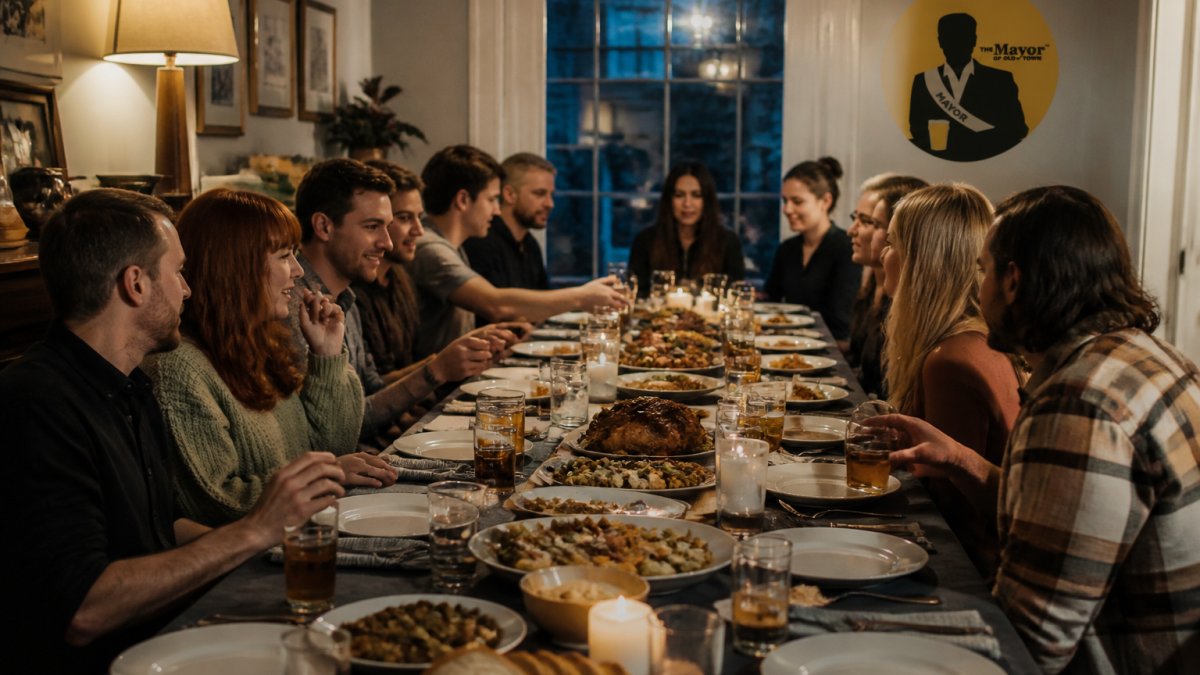
Service style decides how much work lands on you during the meal, and seating layout decides whether guests can reach the food. Get both right and the dinner runs itself.
Start With the Capacity Math
Before you pick a service style, figure out how many people your space can hold. Two numbers matter: table width per guest and circulation space.
- Table width: plan 24 inches of table edge per guest. Below 22 inches, elbows collide and plates crowd. At 30 inches, guests have room to set down a drink and a bread plate.
- Circulation: leave at least 36 inches of clear walkway behind seated guests so people can get up without asking the whole row to move. In a tight room, 32 inches is the floor.
- Buffet clearance: a serving line needs 36 to 42 inches of standing room in front of the table, plus a clear path behind it so the line doesn’t back into the dining table.
A standard 8-foot folding table seats 8 comfortably at 24 inches per person, or 10 with some crowding. Two 8-foot tables end to end seat 16 to 20. A 60-inch round seats 8; a 72-inch round seats 10.
Match the Layout to the Room
| Home Layout | Best Seating Approach | Comfortable Max |
|---|---|---|
| Small dining room | Push tables against walls, use benches | 8-10 |
| Open-concept kitchen | One long table, kitchen island as buffet | 12-16 |
| Living room with no table | Rent folding tables, seat in a U-shape | 14-18 |
| Backyard or patio | Long rented tables, family-style service | 20+ |
A U-shape or L-shape works when you have more guests than one long table can hold. Push the open end toward the kitchen so the serving path stays short. For groups over 20, split into two tables; conversation breaks down past about 8 feet of table length anyway.
Pick the Service Style That Fits Your Help
| Service Style | Best For | Host Workload | Watch Out For |
|---|---|---|---|
| Family-style | 8-12 guests | Low during meal, high at plating | Needs table space for platters |
| Buffet | 12+ guests | Low during meal, medium at setup | Line jams; use two lines |
| Plated | Formal meals under 12 | High throughout | Requires servers or a partner |
| Potluck | Casual groups any size | Lowest | Uneven courses; assign categories |
| Catered | 20+ or no kitchen capacity | Lowest | Coordination and lead time |
Family-style means big platters go in the middle and guests pass them. It feels warm and communal, but needs a table long enough for platters to reach everyone, and works best with two of each dish so no one waits on a single bowl.
Buffet means food sits on a counter or island and guests serve themselves.
Plated service is the most formal and the most work. Unless you have help, save it for groups under 12.
For buffets over 16 guests, set the plates at the head of the line, then mains, then sides, then utensils at the end. Guests who grab a fork first have nowhere to put it, and the line stalls.
Transitioning from a residential dining space to a professional venue necessitates a careful evaluation of meeting room requirements to ensure that the flow of service remains as seamless as the hospitality provided at home.
Your Large Group Dinner Timeline, Start to Finish
A large group dinner timeline keeps the last hour calm. Move most of the work to the days before, and build the menu around dishes that hold well or finish in the oven while guests arrive.
Build the Menu Around Three Buckets
Sort every dish into one of three buckets before you write the shopping list:
- Make-ahead (2-3 days out): braises, chili, casseroles, bean salads, coleslaw, salad dressings, desserts that keep.
- Day-of morning: roasted proteins, sheet-pan vegetables, rice pilaf, pasta bake.
- Last 30 minutes: anything that must be warm and crisp, plus assembly of build-your-own bars.
A menu that leans on the first bucket is the difference between a calm host and a frantic one. Aim for at least half the dishes done 24 hours out.
Sample Menu for 20 Guests
- Main: pulled pork (8-10 lbs raw shoulder), cooked 2 days ahead, reheated in a slow cooker
- Starch: rice pilaf (5 quarts cooked), made morning of, held warm
- Vegetable: roasted sheet-pan vegetables (5 quarts), roasted morning of, served at room temperature
The Full Timeline
Two weeks out:
- Send invitations with a hard RSVP date
- Confirm the guest count and add a 2-3 seat buffer
- Decide the service style and layout
One week out:
- Finalize the menu and lock the three buckets
- Write the shopping list, split into non-perishables and fresh items
- Confirm guest contributions and assign categories, not dishes
Two to three days out:
- Shop for non-perishables
- Cook and cool freezable dishes; refrigerate or freeze
- Clean in stages: bathrooms first, then common areas
One day out:
- Shop for fresh items
- Prep vegetables, chop ingredients, make dressings
- Set the table and stage serving dishes and utensils
Day of, morning:
- Cook the main dishes
- Assemble make-ahead sides
- Reheat braises in a slow cooker or low oven
Day of, 90 minutes out:
- Set out snacks and non-alcoholic drinks
- Warm food 30 minutes before guests arrive
- Put out plates, utensils, and napkins at the head of the buffet line
The last 30 minutes: stop cooking. Put out the food, pour the drinks, and let the meal run itself.
Cook your main dish the morning of, then hold it warm in a low oven or slow cooker set to its lowest setting. You’ll walk into the dinner relaxed instead of frantic, and the food stays safe to serve for the length of the meal.
Cool large batches of braised or stewed food quickly before refrigerating. Split a big pot into shallow containers so it drops out of the temperature danger zone within two hours, then reheat to steaming before serving.
Dietary Needs, Allergies, and Sharing the Work
A guest with a food allergy needs a clear answer, not a guess, so ask about dietary needs when you send the invitation. Label every dish with its main ingredients, an index card next to each platter saves a dozen questions and keeps guests safe.
- Ask about needs at RSVP time
- Label dishes with main ingredients
- Keep separate serving utensils
Sharing the work is the other half of a calm dinner. A potluck spreads the load and gives guests a role. Assign categories instead of dishes: one person brings a salad, another a dessert, another drinks.
Never promise a dish is allergen-free unless you made it and know every ingredient. A wrong answer here has real consequences, so point guests to the labeled dishes and let them decide.
When to Move the Party to a Venue Instead
Sometimes the smartest host move is not to host at home. If your guest count tops your seating, your kitchen can’t hold the food, or you don’t want the cleanup, a venue solves all three at once.
Signs it’s time to book a spot:
- Guest count exceeds your comfortable seating by 4 or more
- You have no room to stage a buffet
- The group wants a special occasion feel
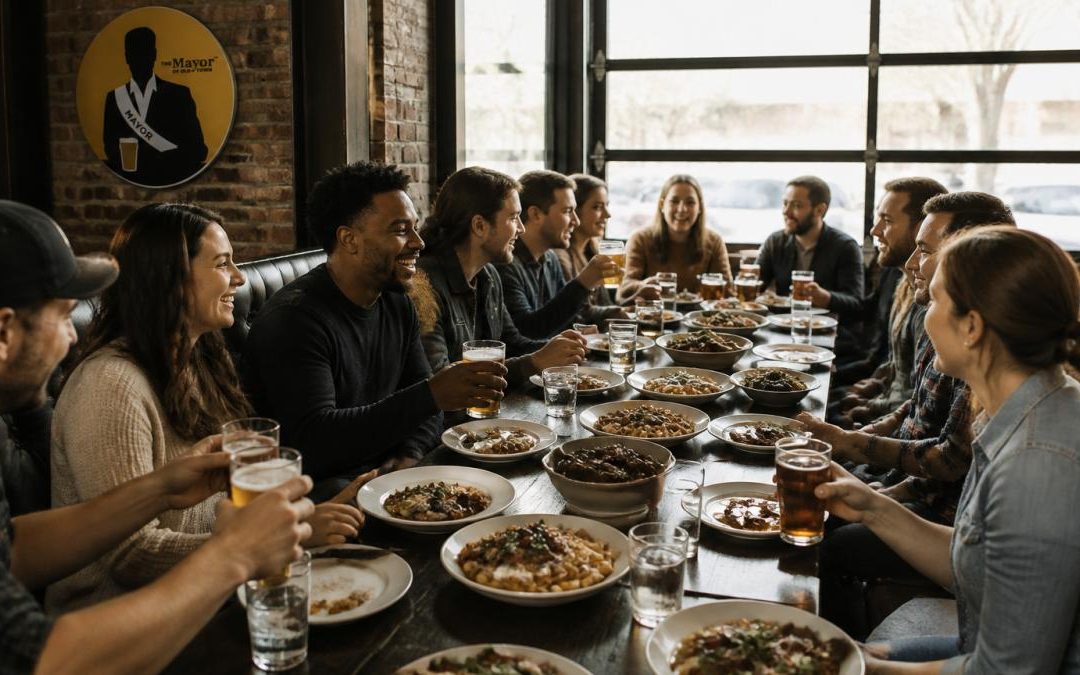
A venue handles the space, the food, and the cleanup, so you get to sit with your guests instead of hovering over the stove. For a Fort Collins crowd, The Mayor of Old Town offers a laid-back setting with a food menu built for groups and a beautiful patio.
Groups of 12 or more who want a relaxed night out without the cooking, the seating puzzle, or the dishes.
Frequently Asked Questions
How far in advance should I start planning a large group dinner?
For 12 or more guests, send invitations two to three weeks out and ask for RSVPs one week before. That window gives you time to build a menu, shop for non-perishables, and adjust the guest count before you commit to food quantities. If your dinner lands on a holiday weekend or a busy season like graduation, add another week. A simple large group dinner planning checklist with dates attached keeps the whole process on track.
How much food should I prepare per person for a large group dinner?
Plan on roughly 1 to 1.5 pounds of food per person when you are serving a main plus sides. For a buffet, estimate about 6 ounces of protein, 4 to 6 ounces of starch, and 4 ounces of vegetables per guest, then add 10 percent extra as a buffer. Appetizers run about 4 to 6 bites per person for the first hour. Round up rather than down, because running short is far more stressful than sending leftovers home.
What are the easiest meals to serve to a crowd?
One-pot and sheet-pan dishes scale best: chili or pulled pork in a slow cooker, baked pasta, taco or fajita bars, and roasted chicken with tray-roasted vegetables. They hold at serving temperature, need minimal last-minute work, and let guests serve themselves. Pair them with a green salad, bread, and a fruit platter. Choosing easy meals for large groups means picking dishes that can be made ahead and finished in the oven or on the counter.
How do I handle dietary restrictions and food allergies at a big dinner?
Ask about allergies and dietary needs on the invitation itself, with a clear deadline for replies. Label each dish with its main ingredients so guests can decide for themselves, and keep serving utensils separate for anything containing common allergens. Offer at least one protein, one starch, and one vegetable option that fit the most common restrictions. If you are hosting at a bar or restaurant, call ahead so the kitchen can plan around the group’s needs.
Hosting a big group dinner doesn’t have to mean a stressful week and a frantic final hour. The hosts who stay calm are the ones who lock the guest count early, pick food that scales, and share the work. If you’d rather skip the planning entirely, The Mayor of Old Town gives your group a welcoming space, an extensive food menu, and room for larger parties. Get started with online ordering and let us handle the food while you enjoy the company.